
Industry News
How to choose outdoor heating? Understand various outdoor heating equipment in one article
- ReleaseTime: 2026-10-20
In autumn and winter, scenes such as courtyard gatherings, outdoor shops, camping and picnicking, and temporary work on construction sites often require heating in open or semi open spaces. Household heaters rely on air convection to heat up, and in outdoor environments, the heat is easily blown away by the wind, making it almost ineffective for heating. Most outdoor dedicated heating equipment adoptsInfrared radiation heatingThe principle is similar to sunlight, which directly heats the human body and objects, rather than air. It has stronger wind resistance and is specifically suitable for special environments such as outdoor and semi shaded areas. According to usage scenarios and fuel types, outdoor heating equipment can be divided into five categories to meet different needs.
1、 Umbrella style gas heating stove (mainstream model for commercial courtyards)
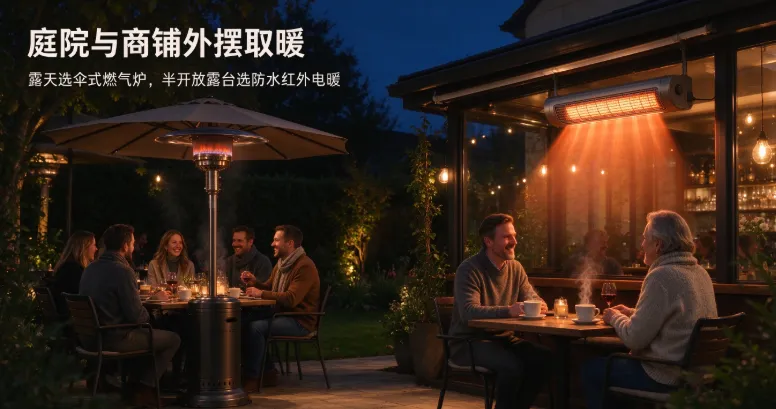
Umbrella gas heating stove is also the most common outdoor heating equipment in restaurants, terraces, night markets, and private courtyards, with liquefied propane gas as the fuel. The equipment is a vertical structure with a large reflective umbrella at the top. The heat generated by combustion is projected upwards and radiated downwards through the umbrella surface reflection. The coverage range can reach 10-30 square meters, and the power is generally between 40000 and 50000 BTU. It can be turned on and heated immediately without the need for external power supply. The bottom comes with a roller, making it very convenient to move.
The advantage lies in the absence of wiring restrictions, large-scale heating, and suitability for outdoor areas without power supply; The equipment comes standard with flameout protection and a tilting gas cut-off device. In case of tilting or flame extinguishing, the gas will be automatically cut off. The disadvantage is that it requires a matching liquefied gas cylinder, which is relatively troublesome to replace, and the heating effect will significantly decrease in strong wind environments. Simultaneously burning consumes oxygen and produces carbon dioxide,It is strictly prohibited to use it inside a sealed tentWhen using semi enclosed spaces such as eaves, ventilation must also be ensured.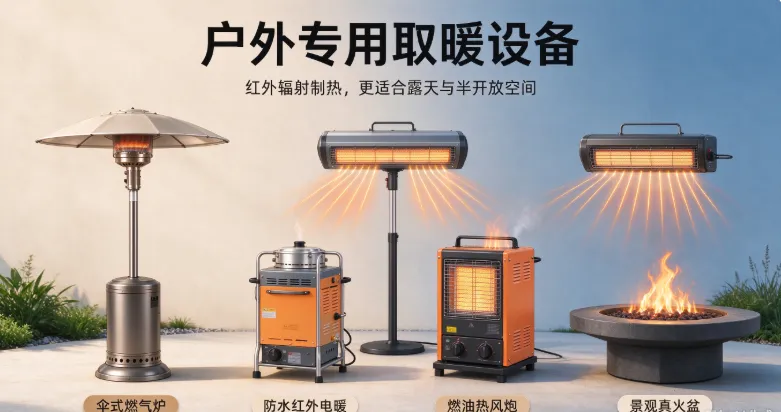
2、 Outdoor waterproof far-infrared electric heater (preferred for semi open spaces)
Outdoor far-infrared electric heaters are available in two forms: floor standing tower type and wall mounted suspended. They use carbon fiber or quartz infrared heating tubes and have an IPX4 waterproof shell. They can be placed in semi open areas such as canopies, terraces, and corridors. Ordinary household infrared heaters do not have waterproof capabilities and cannot be used outdoors. The power is mostly between 1500W and 3000W, and can be supplied by a 220V civilian power supply.
Its core advantages are no open flame, no exhaust gas, no smoke, quiet operation, and no consumption of oxygen. Relying on infrared radiation for directional heating, only heating people and objects within the irradiation range, slight wind does not take away heat, maintenance is simple, and there is no trouble with fuel replacement. The disadvantage is that there must be a stable power supply, and the heat is directed and the coverage area is relatively limited. If it exceeds the irradiation range, the warmth cannot be felt, which is not suitable for large outdoor areas.
3、 Camping portable heating equipment (outdoor, ice fishing, tent scenes)
There are multiple lightweight and portable heating devices available for mobile scenarios such as camping, ice fishing, and emergency tents.
-
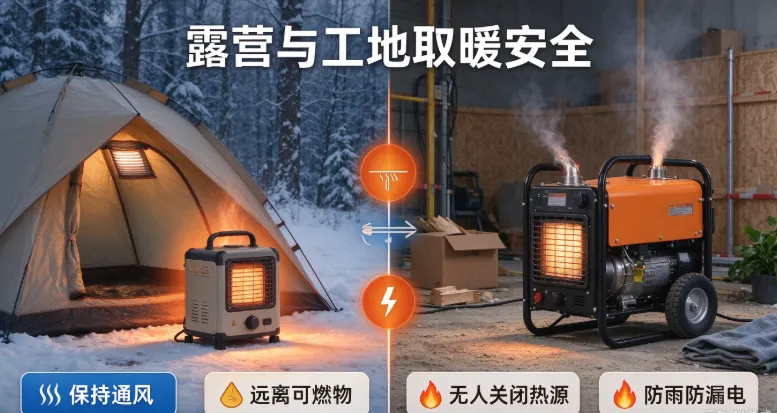
Small card/propane radiant heaterUsing a small gas cylinder, it is compact in size, foldable, and comes with oxygen deficiency protection and dumping protection. Suitable for short distance camping, ice fishing and heating. Important reminder: Ventilation openings must be reserved for use inside tents to prevent carbon monoxide poisoning. It is not recommended to open closed tents for extended periods of time.
-
Firewood stove and biomass pellet stoveUsing firewood and wood chips as fuel, it can provide both heating and cooking water, making it easy to obtain fuel in the wild. The disadvantage is the presence of open flames, the generation of smoke, high fire prevention requirements during use, and the need to clean up ash.
-
Parking diesel and diesel heatingCommonly used for RVs and large engineering tents, diesel combustion produces hot air through a heat exchanger, and the exhaust gas is discharged to the outside through a separate pipeline. There is no open flame on the heating side, and the heat is stable and continuous; The equipment requires a small amount of electricity to maintain operation, and the core is to ensure that there is no leakage in the exhaust pipeline and avoid the backflow of exhaust gas.
4、 Outdoor fuel air heater (construction site, large temporary site)
Fuel air heaters, commonly known as hot air guns, use diesel as fuel and are commonly used for winter construction on construction sites, outdoor large-scale temporary activities, engineering antifreeze, and material insulation. They are divided into direct combustion and indirect combustion types. Direct fired version: Hot air will mix with combustion exhaust,Can only be used in a completely outdoor environmentThe heating rate is extremely fast, suitable for large-scale rapid heating; Indirect combustion system: The combustion system is isolated from the hot air, and the exhaust gas is discharged separately, sending out clean hot air. It can be used for semi open engineering tents and temporary shelters.
This type of equipment has huge power, high heating efficiency, and is suitable for large-scale field operations. But the fuel cost is high and the equipment noise is too loud. Combustion type models must be well ventilated and exhaust emission managed.
5、 Landscape True Fire Heating Equipment (Courtyard Leisure Atmosphere Style)
Gas braziers and wood fire pits are outdoor equipment that combine heating and atmosphere, often used for gatherings in private yards and leisure areas. The open flame creates a strong atmosphere in the scene, and some styles can also be used to grill food. The disadvantage is that the heat is concentrated in a close range, the effective heating area is small, there is an open flame, and the surrounding area must be kept away from combustible materials such as green plants and fabrics. During use, someone needs to supervise the entire process.
Quick selection reference
-
Outdoor restaurant, courtyard, no external power supply: umbrella type liquefied gas heating furnace
-
Rainshed, semi open terrace, with electricity, pursuing cleanliness without open flames: waterproof far-infrared electric heater
-
Wilderness camping, ice fishing, short distance outdoor activities: small propane heater, optional firewood stove without fuel in the wilderness
-
Construction sites and large outdoor temporary venues require rapid and large-scale heating: fuel powered warm air heaters
-
Courtyard gathering, balancing atmosphere and local heating: gas brazier, wood pit
General safety regulations for outdoor heating
-
Combustion heating equipment such as gas, fuel, and firewood are used in semi enclosed spaces such as sheds and tents,Ventilation must be ensuredIt is recommended to install a carbon monoxide alarm to prevent the risk of poisoning.
-
When the equipment is running, at least 1 meter of safety distance should be reserved around it, away from combustible materials such as fabrics, green plants, and cardboard boxes, and the equipment should not be covered.
-
Priority should be given to using infrared radiation heating equipment in windy environments; The heat generated by convective hot air equipment is easily dissipated by the wind, greatly reducing the heating efficiency.
-
Ordinary household heaters should not be placed outdoors. Without waterproof protection, they are easily damaged in rainy weather and may even pose a risk of electric leakage.
-
When the equipment is unattended, it is necessary to turn off the heat source and it is not recommended to run it overnight for a long time.
-
Choose electric heating products with 3C certification and prioritize models with overheat protection and power outage function.
Contact Us