
Industry News
Understanding the safety protection of heaters: choose the right and use them well, and feel at ease during the winter
- ReleaseTime: 2026-11-17
As the temperature drops, heaters have become the preferred choice for many households and offices to replenish heat. There are many types of heaters on the market, and the heating experience and applicable scenarios of different models vary significantly. Safety performance is the most concerned focus for everyone. Only by fully understanding the characteristics and safety mechanisms of heaters, and using them in a standardized manner, can we keep warm during winter and avoid risks.
The application scenarios of heaters are very wide, covering multiple fields such as homes, offices, commercial industries, etc. At home, different spaces are suitable for different types of heaters. The bedroom is suitable for electric oil heaters and electric film heaters, with silent operation, no wind, stable heat storage, and less likely to cause dry air. It is suitable for long-term use by the elderly and children at night; The living room has a large space, so priority should be given to using baseboards and graphene convection heaters to achieve full house heating through air convection without occupying indoor space; The bathroom environment is humid, and a dedicated heater with IPX4 waterproof rating must be selected. Ordinary oil heaters and small sunshades are strictly prohibited from being placed in the bathroom; Local heating for desks and workstations can be achieved by choosing a small PTC heater with fixed-point speed heating, which is more energy-efficient. In addition, the heater can also assist in drying small clothes such as socks and towels, dehumidifying shoe cabinets and wardrobes on rainy days, and can also be used for insulation in pet beds.
In office settings, open workstations are suitable for small desktop warm air heaters for individual local heating; Independent offices and conference rooms can choose baseboards and European style fast heating stoves, which provide uniform heating and low noise, making up for the problem of insufficient air conditioning heating. Commercial and industrial scenarios such as shops, workshops, warehouses, and greenhouse farming generally use gas and oil industrial warm air blowers, which can quickly increase the temperature of large spaces and temporary sites, and meet the temporary insulation needs of tents, activity board houses, and so on.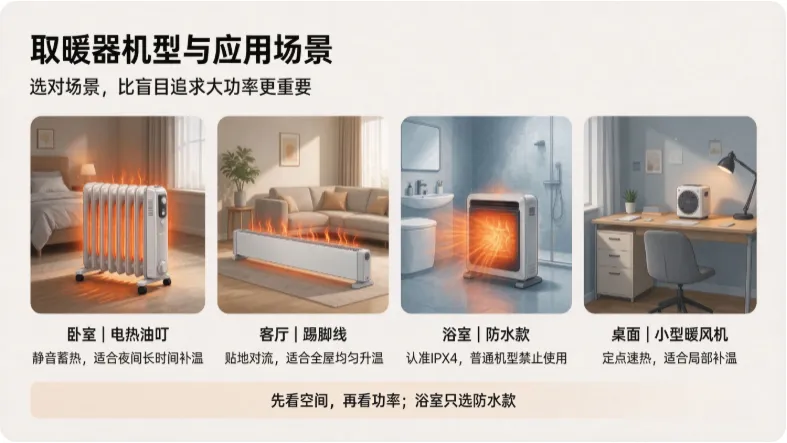
The mainstream heaters on the market have their own advantages and disadvantages: the small sun relies on quartz tube radiation for heating, heats up quickly, and is suitable for single person fixed-point heating, but the surface temperature of the heating tube is extremely high, the strong light is dazzling, and the safety risk is relatively higher; PTC warm air blower can be turned on and heated immediately, with a small size, but the operation of the blower will produce noise, which can easily dry the air; Electric heating oil tank has strong heat storage capacity, soft and quiet body feel, but the disadvantage is slow heating speed and heavy body weight; Skirting boards and graphene convection heaters dissipate heat evenly, and many styles have anti scald shells that are suitable for whole house heating. Waterproof models can also be used in bathrooms.
Safety is the core of heater use. Regular heaters with 3C certification follow the GB/T 4706.23 indoor heater safety standard, come with multiple protective mechanisms, and have a reliable safety foundation. The vast majority of safety accidents come from three no products and non-standard use. Qualified heaters come standard with overheat protection, grounding protection, and flame-retardant casing. Waterproof models have corresponding waterproof levels, and some models also add advanced protection such as anti scald casing, child lock, and timed shutdown. Among them, tipping off power is a crucial safety design and a frequently asked protection function.
The power outage caused by dumping mainly relies on the principle of gravity induction, and there are three common structures. The first type is the ball gravity switch, which is also the most commonly used solution for oil heaters, small sunshades, and ordinary warm air blowers. Conductive steel balls and contacts are placed inside the base, and when the machine is upright, the steel balls press against the contacts, and the circuit is conductive and works normally; When the machine tilts more than 30 °~45 °, the steel ball rolls away from the contact, the circuit is disconnected, and the heating power is cut off. The structure is simple and the cost is low. The disadvantage is that it is easy to trigger by mistake during vibration, and the contact may oxidize after long-term use. The second type is a bottom press micro switch, which is commonly used for tower heaters and some skirting line heaters. When the machine is placed steadily, the weight of the whole machine presses down on the top pin, and the switch is closed and powered on; Once overturned and lifted off the ground, the ejector pin will pop up and the switch will disconnect and cut off power. This switch has a short board, and if placed on thick carpets or sunken floors, it may not be pressed in place, causing protection failure. The third type is the photoelectric ball tilt switch, which is mostly used in new high-end models. It relies on infrared light path to identify the position of the steel ball. After tilting, the steel ball slides open, and the motherboard receives the signal and cuts off the heating power. It belongs to the design without mechanical contacts, has a longer service life, and is not easy to ignite or oxidize. It should be noted that most power outages during dumping only cut off the heating circuit, not the main power supply of the plug. The indicator light circuit may still be live, and it and overheat protection are two independent safety mechanisms that cannot be replaced by each other. Old mercury switches have been largely phased out due to environmental restrictions.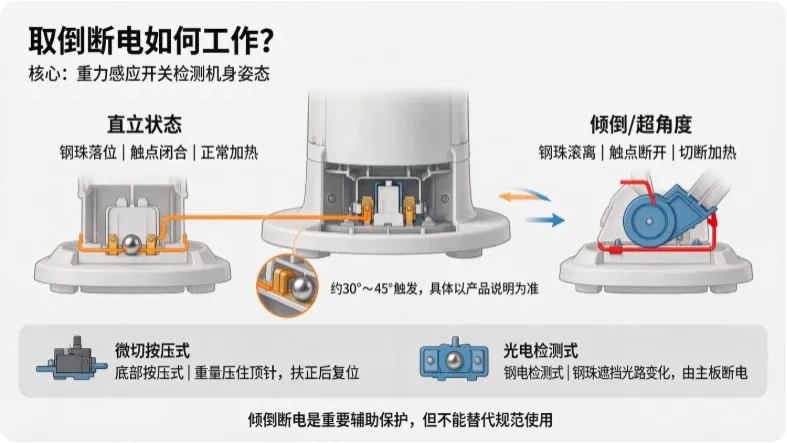
The safety risks of heaters are concentrated in the following points: covering the heater with clothes or towels, blocking the heat dissipation port, and preventing heat from dissipating, which can easily lead to fire; The power of most heaters is between 1500-2200W, which belongs to high-power appliances. When connected to ordinary sockets, shared sockets with high-power appliances such as electric kettles and induction cookers, it is easy to cause circuit overload; Heating too close to combustible materials such as curtains, bedding, sofas, cardboard boxes, etc. can also cause hidden dangers; Three no products will cut corners and avoid tipping, power outages, overheating protection, insufficient power cord diameter, and non flame retardant shells, which are the sources of high accident rates; Long term close contact with high-temperature shells also poses a risk of low-temperature burns; Continuing to use the oil tank after oil leakage or aging of the power cord can cause electric leakage and fire.
To safely use a heater, it is important to remember these rules: when purchasing, identify 3C certification and prioritize products that are equipped with both dumping power and overheating protection; It is strictly prohibited to bake clothes on the heater and place them away from the bed surface and thick carpets; Try to use wall plugs directly and avoid using row plugs indiscriminately; Keep a distance of at least 1 meter between the heater and combustible materials, and do not place the socket directly above the heater to avoid overheating and damaging the socket; It is recommended to turn off the heater when leaving the room or resting at night; The bathroom only uses IPX4 waterproof model; Once the power cord is damaged, the shell is deformed, the oil tank leaks oil, or frequent tripping is found, immediately stop using it.
You can also perform a simple self check on the tilting and power-off function of the heater in daily life: after turning on, gently tilt the machine, and if it can immediately stop heating, it is in a normal state. Although dumping power off is useful, there is also the possibility of switch jamming, contact welding and other failures, which can only be used as auxiliary protection and cannot be completely relied on.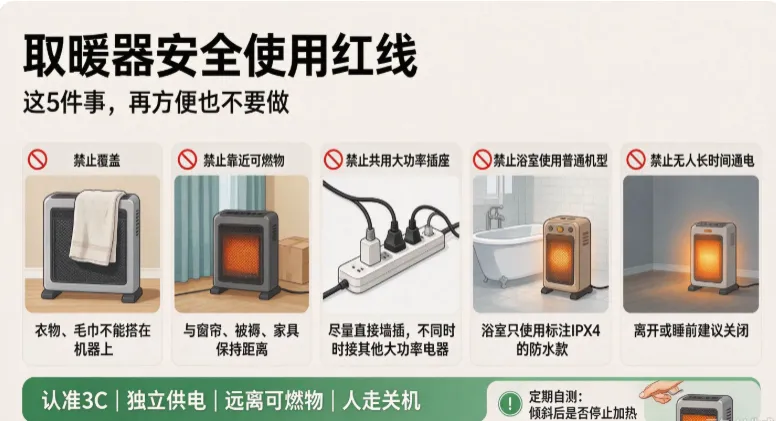
The heater brings us warmth, but the safety bottom line cannot be relaxed. Only by selecting the right model, distinguishing applicable scenarios, understanding the built-in security protection mechanisms, and developing standardized usage habits can one enjoy warmth with peace of mind.
Contact Us